5 STAR QUALITY SERVICE
How Much PPF Coverage Does Your Car Need? Partial Front, Full Front, or Full Body
Most drivers land on full front coverage. If your car is light-coloured, garage-kept, and rarely leaves surface streets, partial front or bumper-only is genuinely enough. Full body earns its price on a vehicle you plan to keep for years, or one where the paint is a large share of what the car is worth.
The harder part is that shops do not sell "partial front" and "full front" by those names. They sell packages. Below, each coverage level is matched to the
paint protection film packages you can actually book at Mike's Tint Shop, with the panels included, the starting price, and how many days the car is in the shop. That last number matters more than most people expect when you only own one car.

The Short Answer by Driving Profile
- City driver, light paint, parks in a garage. Bumper only. The bumper takes the first and hardest hits, and on silver or white paint, the chips you do get are the least visible.
- Mixed surface streets and occasional freeway. Partial front. Bumper, mirrors, and the leading portion of the hood and fenders.
- Regular freeway commuter, any paint colour. Full front. Everything ahead of the A-pillars, headlights included, with no film line across the hood.
- Keeping the car five years or more, or the paint is a big part of its value. Full body. Every painted panel plus the roof, trunk, and rear fenders.
What Each PPF Coverage Level Actually Covers
Bumper Only: The Tier Nobody Writes About
Almost every guide on this topic starts at partial front, which skips a real option. The front bumper meets road debris first, at the steepest angle, on every drive. Protecting it alone covers most chip events on a car that lives on surface streets.
At Mike's Tint Shop, this is the STANDARD package, starting at $899 with a one-day turnaround and a 10-year warranty. Extended patterns with full overlap coverage are available at an additional cost if you want the film carried further around the bumper edges. What it leaves bare is the hood, the fenders, and the mirrors.
Partial Front: Coverage With a Visible Line
Partial front adds the mirrors, the partial hood, and the partial front fenders to the bumper. The hood piece typically runs 18 to 24 inches back from the leading edge, which is where the film stops. Sometimes called a bikini line, that stopping point is the honest trade-off of this tier: on most cars it sits inside your eyeline from the driver's seat, and the paint behind it keeps taking hits.
This is the PERFORMANCE package, starting at $1,099, with a one-day, 10-year warranty. It is the right call when budget is the binding constraint, and you want more than the bumper covered.
Full Front: The Line Disappears
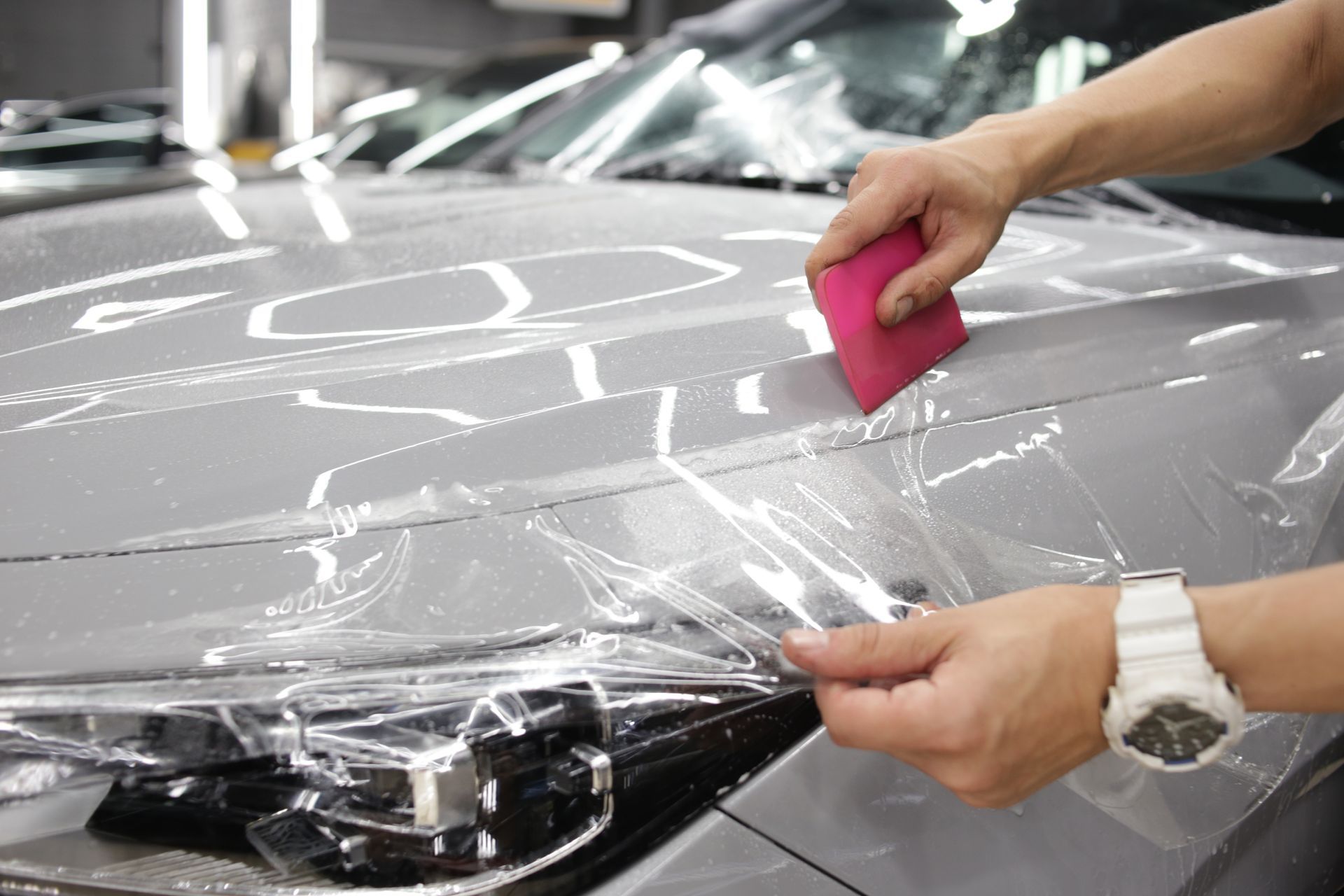
Full front covers the front bumper, the full hood, the full front fenders, the mirrors, and the headlights. Because the film wraps the leading edge of the hood rather than being trimmed partway across it, there is no transition line to look at and no unprotected strip sitting behind one.
This is the ULTIMATE package, starting at $2,299, with the same one-day turnaround and 10-year warranty as the tiers below it. For most drivers putting real freeway miles on a car, this is where protection and cost meet. You can see how the finished edges look on our recent PPF work.
Full Body: Nothing Left Exposed
Full body covers the front and rear bumpers, full hood, mirrors, full front fenders, full rear fenders, roof, trunk, headlights, fog lights, and door edge guards. There is no boundary anywhere on the car between filmed and unfilmed paint, which means no difference in gloss or wear developing between them over the years.
The FULL BODY PPF package starts at $5,500 and takes three to five days, since every panel is fitted individually. If you want protection, correction, and coating handled in one visit instead, the Signature Protection Package starts at $3,000 and combines front bumper and full hood PPF with full vehicle paint correction, ceramic coating on all painted surfaces, front window and windshield tint, and a full exterior detail.
Film is not limited to clear gloss. Matte paint protection film preserves a satin finish while protecting it, and colour change paint protection film changes the car's colour with the factory paint untouched underneath.
What Partial Coverage Leaves Exposed
Choosing a tier is easier backwards. Every package is defined as much by what it does not cover as by what it does.
- Bumper only leaves the hood, fenders, mirrors, and everything behind them bare.
- Partial front leaves roughly two-thirds of the hood, the rear portion of the fenders, the headlights, and the entire rest of the car bare.
- Full front leaves the doors, rocker panels, roof, trunk and rear bumper bare. Rockers and lower doors matter more than people assume, because they take spray thrown up by your own tyres.
- Full body leaves nothing bare. Door jambs and window trim are not standard on any package and should be asked about specifically if you want them.
Why Headlights Are the Real Dividing Line
Headlights are the specific difference between the PERFORMANCE and ULTIMATE packages, and they deserve more attention than they usually get in coverage guides.
Modern headlight lenses are polycarbonate, not glass. They yellow and haze under sustained ultraviolet exposure as the factory hard coat breaks down. That is a predictable process rather than an unlucky one, and in Southern California sun it runs fast. Restoration buys a few years. Replacement on a newer vehicle with projector or adaptive units is not a small bill.
Film over the lens blocks the UV that causes the hazing. If you are weighing PERFORMANCE against ULTIMATE and the price gap is the sticking point, the headlights alone are a reasonable argument for the upgrade.
How Southern California Driving Changes the Math
Most advice on this topic comes from Denver, Houston, and Michigan, built on road salt and freeze-and-thaw cycles. None of that applies here. Our exposure profile is different, and it changes which tier makes sense.
- Sustained UV, year-round. There is no off-season for sun damage in Orange County or the Inland Empire. It works on clear coat, on headlight lenses, and on interiors. Pairing film with ceramic window tint handles the exterior and the cabin together.
- Stop-and-go grit. Congestion on the 91, 5, 55, 57, 22, and 405 puts you close behind other vehicles for long stretches. Debris lands on the bumper and lower hood at short range rather than at high speed, which is exactly the area the bumper only and partial front cover.
- Construction and open shoulders. Long-running roadwork through the Inland Empire corridors means loose aggregate and steel plate edges on routes people drive daily.
- Santa Ana wind grit. Wind events drive fine abrasive material across paint, which produces dulling and light scratching rather than chips.
- Coastal salt air. If you park near the water, airborne salt accelerates oxidation on exposed clear coat. Filmed panels are insulated from it. Unfilmed ones are not.
Mike's Tint Shop has run shops in this region since 1989, so our recommendations are built on what these specific roads do to paint. See the full breakdown for vehicle protection in Orange, CA.
Four Questions That Decide Your Tier
How many freeway miles do you drive each week? Under fifty, bumper only or partial front covers the realistic risk. Over a hundred and fifty, go full front. The debris you meet at 65 mph behaves differently from the debris you meet at 30.
Where does the car sleep? A garage removes UV, sap, droppings, and dust from the equation for two-thirds of the day. An open driveway or a lot under trees does not, and pushes the case toward fuller coverage on the roof, trunk, and rear panels.
How long are you keeping it? Trading in two or three years, full front protects the panels a used car appraiser looks at first. Keeping it five to ten years, full body stops damage from compounding on panels you would otherwise be paying to correct later.
What colour is the paint? Dark paint shows chips and swirls far more readily than silver or white, and it is harder and costlier to match in a repair. On a black or deep blue car, move up a tier. The same goes for hard-to-match finishes, including most Tesla and EV paint.
When You Should Not Buy More Coverage
If the car is a light coloured commuter that sleeps in a garage, covers short surface street trips, and will be sold within a couple of years, full body is over-buying. The bumper and hood edge are where your damage will happen. Spend there and put the difference toward tint or a coating.
One caveat before you decide. Film is fitted panel by panel either way, so adding coverage later costs more in total labour than buying the right tier once. Upgrading is possible and plenty of owners do it, but starting small and expanding twice costs more than starting where you meant to finish.
Get a Straight Answer on Your Own Vehicle
Coverage is not a one-size decision. It depends on the car, the paint, the miles, and how long you are keeping it, and the only way to get it right is to look at the vehicle.
Mike's Tint Shop has been family-owned and operated since 1989, with locations in Orange and Corona. Every gloss PPF package carries a 10-year warranty; installation is available in the shop or at your location, and financing is available. Call Orange at 657-221-3352 or Corona at 951-298-9043, or request a free price estimate, and we will tell you which tier your car actually needs.
Frequently Asked Questions
Can I add more PPF coverage later?
Yes. Adding panels to an existing install is routine work. The film already on the car does not need to come off. The only cost is that doing it in stages means paying for install labour more than once.
Will I see the film edges?
Where a panel edge allows the film to be wrapped around it, no. Where the panel shape makes wrapping impossible, there is a fine line. On the partial front, there is also a deliberate line across the hood where the film stops. Full front and full body avoid that one entirely.
How long does PPF installation take?
The STANDARD, PERFORMANCE, and ULTIMATE packages are all one-day jobs at Mike's Tint Shop. Full body takes three to five days, because every panel is measured, cut, and fitted individually.
Should I add ceramic coating over PPF?
Many owners do. A coating on top makes the film easier to wash and helps unify the look across filmed and unfilmed panels on a partial install. It goes on after the film, never underneath it, since film needs to bond to paint. See our ceramic coating options for what that adds.
Does the paint need work before the film goes on?
Sometimes. Film seals in whatever is underneath it, so swirl marks or etching should be corrected first rather than locked in for ten years. Paint correction is worth discussing on any car that is not new.
Does PPF go over sensors, cameras and badges?
Film is cut around parking sensors and camera lenses so nothing interferes with how they work, and around badges rather than over them.