5 STAR QUALITY SERVICE
Water Spots on a Ceramic Coated Car: What Causes Them and How to Prevent Them
A ceramic coating makes water bead up and makes water spots easier to remove, but it does not make your paint spot-proof. Water spots are the minerals left behind when water evaporates, and they can still form on a coated car.
Below, we cover why spots still show up on coated paint, what causes them, how to tell how serious they are, how to prevent them, and what to do when they will not wash off.
Why Water Spots Still Form on a Ceramic Coated Car
Water spots come from what is in the water, not from the surface it lands on. Tap water, sprinkler water, and rain carry dissolved minerals such as calcium and magnesium. When a drop evaporates, the water leaves and the minerals stay behind.
A ceramic coating is hydrophobic, so water beads up and rolls off instead of sitting flat. Less water stays on the car, but any bead that dries in place still leaves its minerals behind. Beading is not the same as repelling minerals. We cover how coatings bond and bead in What Is Ceramic Coating and How Does It Work?
Two other points are worth knowing. A 9H hardness rating describes resistance to light scratches, not whether minerals can settle on the surface. And a glossy, reflective finish makes every dried ring easier to see.
What the coating does change is how firmly spots hold on. Fresh spots on coated paint usually sit on the coating rather than the clear coat, so they tend to come off with less effort.
What Causes Water Spots on Coated Paint
Most water spots trace back to water drying on the paint before it is wiped or blown off. The common sources:
- Hard tap water: Hose and bucket water carries dissolved minerals that stay behind as it dries.
- Sprinklers: Irrigation overspray hits the same panels again and again.
- Drying in the sun: Heat speeds up evaporation, so drops dry before you can reach them.
- Dried soap: Shampoo left on the paint, or a rinse that misses an area, dries into a film.
- Rain residue: Rain picks up dust and pollutants and leaves them behind as it dries.
- Air drying: Letting the car drip dry gives every leftover bead time to evaporate in place.
- Dripping overhangs: Parking under eaves or trees lets water fall on the same spot repeatedly.
- Bird droppings, sap, and pollen: These are organic, not mineral, and they can mark the finish if left to sit.
Color is a useful clue. Mineral spots usually look chalky and white, while brownish or yellowish marks usually point to organic contaminants.
The Three Stages of Water Spots
Water spots fall into three stages, and the stage decides the fix. Time and heat move a spot from one stage to the next. The longer minerals sit on a panel, and the hotter that panel gets, the deeper they bond.
- Stage 1, surface residue: Minerals sit on top of the coating. A wash or a quick detailer usually removes them.
- Stage 2, etched spots: Minerals have bonded and started to eat into the surface. The spot stays after a wash, and you can feel a slight edge when you run a clean fingertip across it. These usually need polishing.
- Stage 3, craters: The etching is deep enough to see as small pits in the finish. Fixing it means polishing the whole area and, in severe cases, refinishing the paint.
Two quick checks tell them apart. Wash and dry the panel first; if the spots are gone, they were stage 1. If they remain, run a clean fingertip lightly over them. A spot you can feel sits below the surface and needs more than a cleaner.
How to Prevent Water Spots on a Ceramic Coated Car
Prevention comes down to one goal: do not let water dry on the paint. These habits do most of the work:
- Dry the car right away with a clean microfiber drying towel or an air blower.
- Use filtered or deionized water for the final rinse, since it carries fewer minerals to leave behind.
- Wash in the shade, early in the morning or late in the afternoon, so panels stay cool.
- Park in a garage or covered spot, away from sprinklers and dripping overhangs.
- Use a pH-neutral shampoo and the two-bucket method, and rinse until no suds remain.
- Wipe the car down after rain with a coating-safe quick detailer and a microfiber towel.
- Apply a coating-safe booster or topper spray from time to time. It adds a thin sacrificial layer on top of the coating. We compare coatings with traditional wax in Ceramic Coating vs. Wax.
- Wash regularly. A coating makes washing easier, but it does not replace it. Every two weeks is a reasonable starting point, and more often if the car sits near sprinklers.
How to Remove Water Spots Without Damaging the Coating
Start with the gentlest method and move up only if the spots remain. Each step is more aggressive than the last, so skipping ahead can cost you coating you did not need to lose.
- Wash or detail spray: A proper wash, or a coating-safe quick detailer on a cool panel, clears stage 1 spots.
- Coating-safe water spot remover: These products use mild acids to dissolve mineral deposits. Use them sparingly, on a cool panel, one small area at a time, and follow the label.
- Clay bar: With plenty of lubricant and light pressure, a clay bar can lift bonded minerals a cleaner leaves behind.
- Machine polish: Polishing levels etched spots, but it also removes a thin layer of coating. Any polished area needs the coating reapplied.
A spot that still sits on the surface calls for cleaning, not polishing. Polishing a stage 1 spot only removes coating.
Skip the home remedies. Vinegar, baking soda, and other household fixes show up in a lot of online advice, but acidic and abrasive DIY mixes can harm a coating. Stick with products made for coated paint.
When to Stop and Call a Professional
Stop and have the paint looked at professionally if you notice any of these:
- Spots you can feel with a fingertip after a wash
- Spots that survive a wash and a coating-safe remover
- Spotting across a large area, such as a full hood or roof
- A coating that no longer beads water the way it used to
At that point, the safe fix is usually correction followed by fresh coating. Machine polishing on your own can remove more coating or clear coat than intended. Our paint correction process starts with an inspection of the clear coat to assess the type and severity of defects, then moves to decontamination and cutting, buffing, and polishing based on the package. Each correction package finishes with Ceramic Pro Sport, or you can upgrade to a full ceramic coating package.
How Prep and Coating Layers Affect Long-Term Performance
A coating can only perform as well as the surface under it. Our Bronze, Silver, and Gold packages build that surface step by step:
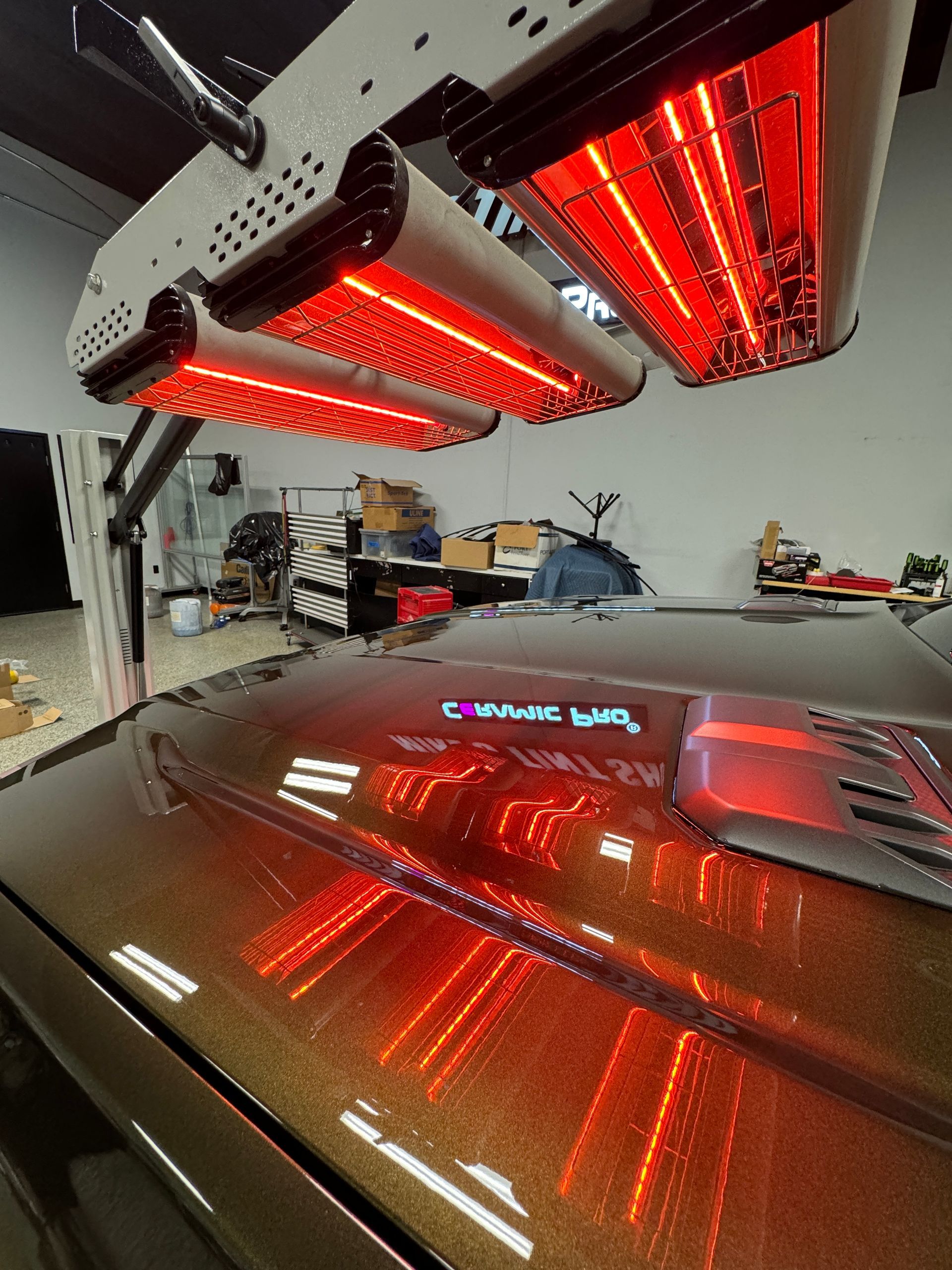
- Bronze: decontamination wash, Level 1 paint correction, 1 layer of 9H, 1 layer of top coat, and infrared (IR) curing
- Silver: decontamination wash, Level 1 paint correction, 2 layers of 9H, 2 layers of top coat, and IR curing
- Gold: decontamination wash, Level 2 paint correction, 4 layers of 9H, 2 layers of top coat, and IR curing
Paint correction comes first because a coating does not fill or fix scratches and swirl marks. It seals in whatever is under it, so correcting the paint gives the coating a smooth, clean base to bond to.
Good prep sets the coating up to last, but it does not replace aftercare. Water spots are a maintenance issue, and the habits above apply to every package.
Ceramic Coating Services at Mike's Tint Shop
Mike's Tint Shop has been family-owned and operated since 1989, and we are a certified Ceramic Pro shop. We offer four ceramic coating packages:
- Sport: starting at $350, 6-month warranty
- Bronze: starting at $1,200, 2-year warranty
- Silver: starting at $1,600, 5-year warranty
- Gold: starting at $1,800, lifetime warranty
We serve drivers from three Southern California locations:
- Orange: 1624 W Katella Ave, Orange, CA 92867, 657-221-3352 (ceramic coating in Orange)
- Corona: 1141 Pomona Rd, Corona, CA 92882, 951-298-9043 (ceramic coating in Corona)
All three locations are open Monday to Friday, 9 AM to 6 PM, and Saturday, 8 AM to 6 PM. Our Orange location is also open Sunday, 10 AM to 5 PM. Call the location nearest you or request a free estimate.
Water Spot FAQs
Can a ceramic-coated car still get water spots?
Yes. A coating makes water bead and roll off, but any drop that dries in place leaves its minerals behind. The coating makes those spots easier to remove, not impossible to form.
Why does my coated car have water spots after a wash?
Usually, the car air-dried, was washed in the sun, or was rinsed with mineral-heavy tap water. Drying right away with a microfiber towel or air blower prevents most post-wash spots.
How do I remove water spots from a ceramic coating?
Start with a wash or a coating-safe detail spray. If spots remain, try a coating-safe water spot remover, then a clay bar. Etched spots you can feel need polishing and a fresh coating.
Will vinegar damage a ceramic coating?
It can. Vinegar is acidic, and acidic home remedies can harm a coating. Use a water spot remover made for coated paint instead.
Can water spots etch through a ceramic coating?
Yes, if minerals sit on the paint long enough, especially in heat and direct sun. Repeated exposure, such as a sprinkler hitting the same panel, raises the risk.
How often should I wash a ceramic-coated car to avoid spots?
Every two weeks is a reasonable starting point. Wash more often if the car sits near sprinklers, and dry it promptly after every wash or rain.