5 STAR QUALITY SERVICE
PPF vs. Ceramic Coating: Which One Actually Protects Against Rock Chips?
Paint protection film stops rock chips. Ceramic coating does not. That is the honest answer, and everything after it is a question of where to spend. Film is a physical layer thick enough to absorb a stone at highway speed. Coating is a chemical layer measured in microns that adds gloss, repels water, and resists etching. If chips are what bother you, our paint protection film packages are the only product here that solves that problem.
That does not make coating a bad purchase; it makes it a different one. Here is how we split a real protection budget, panel by panel.
The Short Answer, Panel by Panel
Ranked by how often each surface actually takes a hit on a daily-driven car:
- Front bumper. Gravel and road debris thrown up by traffic ahead of you. Film.
- Hood leading edge. The first several inches catch most of what clears the bumper. Film.
- Mirror caps and A-pillars. Debris that rides the airflow around the front of the car. Film.
- Rocker panels and door cups. Grit thrown by your own front tires, plus fingernails and shoes. Film if you want it perfect, coating if the budget is tight.
- Roof, trunk, rear quarters, glass, and wheels. Sun, bird droppings, sap, and water spots, not impact. Coating.
Film goes on the panels that get hit. Coating goes on everything else. If you can only pay once, that sentence is the whole decision.

What Paint Protection Film Actually Does
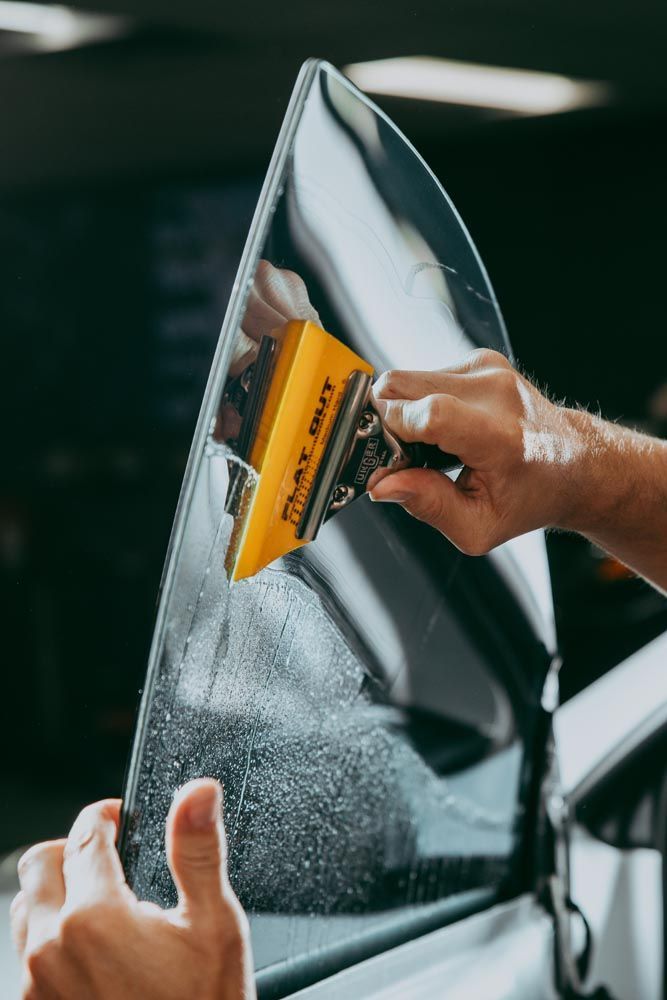
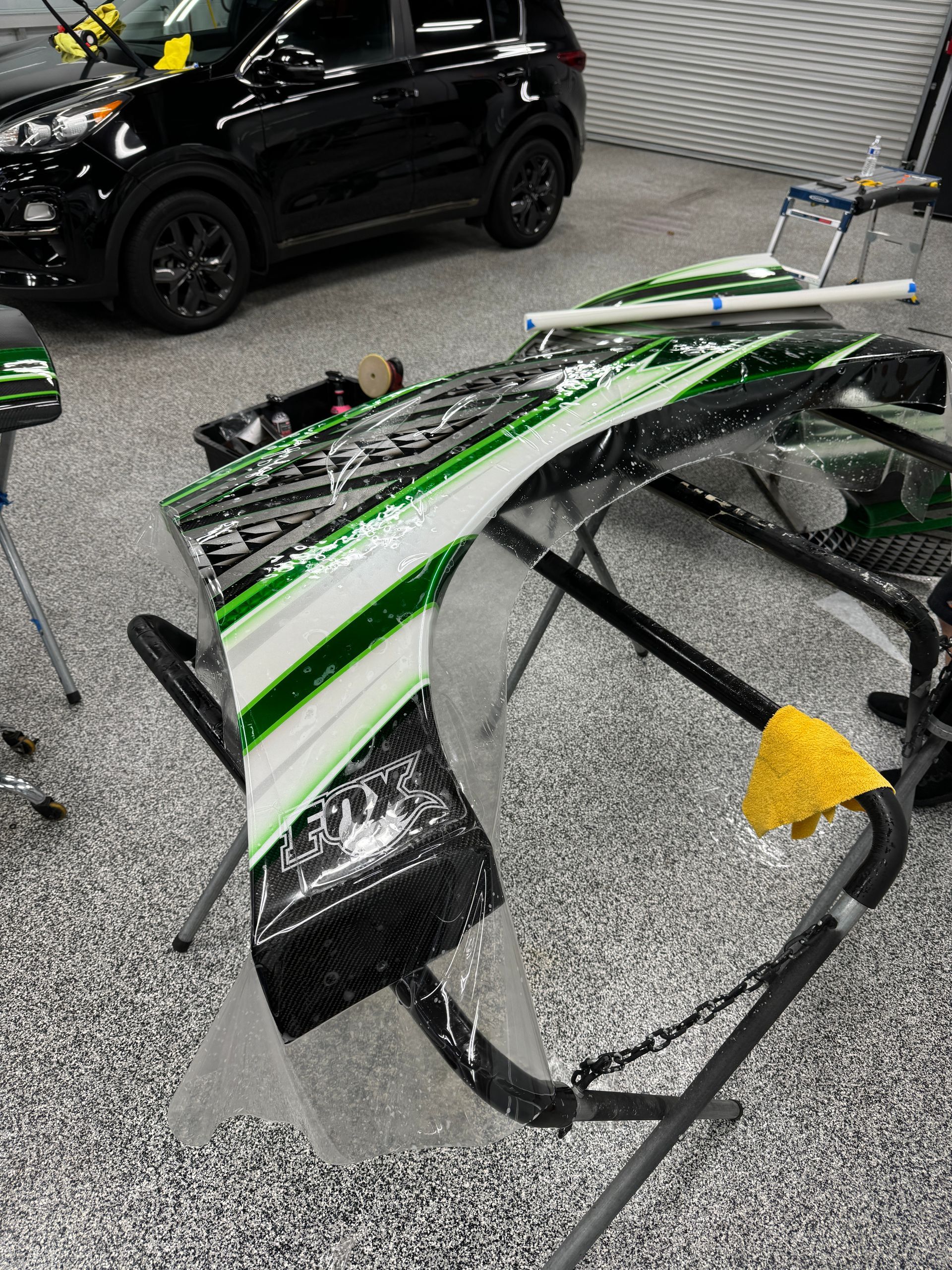
Paint protection film, sometimes called a clear bra, is a transparent thermoplastic polyurethane film applied over your paint. It does not bond chemically to anything. It sits on top as a separate layer with its own adhesive, and it takes the impact your clear coat would otherwise take.
Why Thickness Is the Whole Story
Film in this category runs roughly 6 to 10 mils, or about 150 to 250 microns. A ceramic coating cures at roughly 1 to 5 microns. That is not a difference of degree; it is a difference of category. A stone at freeway speed carries enough energy to fracture a clear coat, and a few microns of cured silica does not change that outcome. Fifty to a hundred times that thickness, in a flexible material engineered to deform and recover, does.
What Self-Healing Fixes, and What It Does Not
Quality film carries a self-healing topcoat. Light swirls and fine scratches in the film surface flow back flat when the panel warms in the sun or under hot water. That is useful for wash marring and brush contact. It is not chip repair. If an impact tears through the film, that section of film is damaged and gets replaced. The point is that the paint underneath is still original, which is the part you cannot buy back.
What Ceramic Coating Actually Does
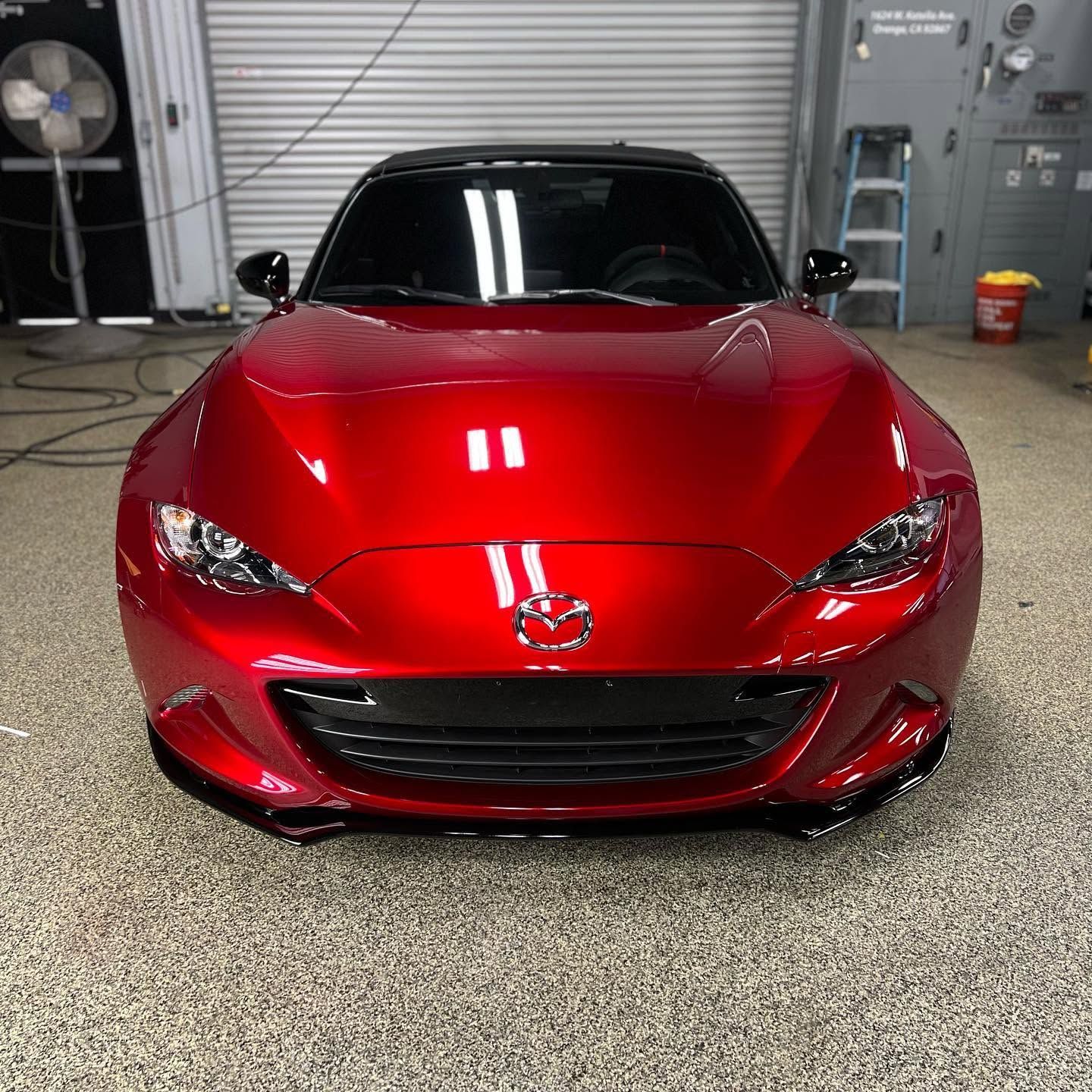
A ceramic coating is a liquid that bonds to your clear coat and cures into a hard, glass-like layer. It is optically clear, it deepens color, and it makes paint look considerably better. That appearance gain is most of why people buy it.
Why 9H Hardness Is Not Impact Resistance
9H is a pencil hardness rating. It describes how well a surface resists being scratched by something drawn across it. It says nothing about how that surface handles a point impact. A pane of glass is hard and still shatters. Hardness and impact resistance are separate properties, and any shop that blurs the two is selling you the wrong expectation.
What Coating Protects That Film Does Not
Our ceramic coating packages earn their keep against the threats that arrive slowly. Bird droppings, tree sap, honeydew, and industrial fallout are acidic and will etch bare clear coat if they sit. Sun exposure oxidizes paint over years. Hard water spots bake into a hot panel. A coating resists all of that across every painted surface, and from our Bronze package up, it also covers glass, headlights, taillights, and wheel faces. Washing gets faster because dirt releases instead of clinging, and less scrubbing means fewer swirls.
One caveat. Standard coatings add gloss, so on a matte or satin finish they change the look. For those cars, matte paint protection film is the better route.
Where Rock Chips Actually Land on Your Vehicle
Chips are not spread evenly across a car. The front bumper takes the clear majority because it meets debris head-on with nothing in front of it. The leading edge of the hood is next, catching what bounces over the bumper. Mirror caps and A-pillars collect smaller particles carried by airflow. Rocker panels get sandblasted by your own tires. The rear of the car is rarely chipped at all, which is exactly why full-body film is a poor first purchase for most owners.
Glass is its own conversation. Windshields chip too, and neither paint film nor a coating helps there. We install windshield protection film starting at $699 using ClearPlex, and ceramic window tint handles heat and UV on the side glass.
Matching Coverage to the Chips You Are Trying to Stop
This is where most buyers lose money. Not by choosing the wrong product, but by choosing a coverage tier that does not include the panel they were worried about. Every gloss film package below carries a 10-year warranty. Soft factory paint, common on Teslas and other newer electric vehicles, marks more easily than older finishes, and our Tesla PPF and vinyl wrap work is built around that.
Standard, from $899
Front bumper only, finished in one day. This is the highest return per dollar we install, because the bumper takes more chips than every other panel combined. Be clear about the limit: it does not cover your hood.
Performance, from $1,099
Front bumper, partial hood, mirrors, and partial front fenders, in one day. For an extra $200 over Standard, you pick up the leading edge of the hood and the mirror caps, which are the second and third most chipped surfaces on the car. For most daily drivers this is the sensible starting point.
Ultimate, from $2,299
Front bumper, full hood, mirrors, full front fenders, and headlights, in one day. Full coverage means no film edge running across the middle of the hood, which some owners prefer visually, and headlight film prevents the hazing and pitting that costs real money to replace.
Full Body, from $5,500
Front and rear bumpers, full hood, mirrors, full front and rear fenders, trunk, door edge guards, headlights, fog lights, and roof, over three to five days. This is preservation rather than chip prevention. It makes sense on a car you intend to keep original, or one where a repaint would cost more than the film.
Not sure which tier fits how you drive? Tell us your commute, and we will tell you the cheapest package that solves it.
What the Warranties Actually Cover
These two numbers get compared as though they mean the same thing, and they do not.
- A 10-year film warranty covers the film itself against yellowing, cracking, and delamination. It does not warrant the paint underneath, and it is not a promise that no chip will ever get through.
- A coating warranty is tied to the tier you buy. Our Sport package carries a 6-month warranty, Bronze 2 years, Silver 5 years, and Gold a lifetime warranty. That covers the coating's performance, meaning gloss and water behavior, for that period.
A lifetime coating warranty and a 10-year film warranty are not competing figures. One is about how long a finish keeps beading water, the other about how long a physical barrier stays clear and stuck down. Neither is a chip guarantee.
The Order Matters: Correction, Then Film, Then Coating
Sequence decides the outcome on a combined job, and it is the step most often treated as a footnote. Paint correction comes first. A coating is optically clear, so it does not fill scratches or swirls; it magnifies whatever is underneath. Film is clear too, so anything you leave in the paint is locked under it and cannot be polished out without removing the film first.
Correct the paint, install film on the impact zones, then coat the whole car including over the film. Coating on top of film slows yellowing, adds water repellency the film does not have on its own, and keeps gloss consistent so your eye does not catch the transition between filmed and unfilmed panels.
When a Ceramic Coating Is the Wrong Purchase
If rock chips are your only concern, do not buy a coating. Our Gold package is $1,800 with a lifetime warranty and four layers of 9H, and it will not stop a stone any better than our $350 Sport package will. Neither will anyone else's. On a fixed budget where chips are the problem, $899 of film on the front bumper beats $1,200 of coating every time.
Buy the coating when you want the car to look better, stay cleaner, and resist etching and sun damage. Those are real benefits; they are just not the one you came to this page for.
Doing Both Without Overspending
For owners who want the whole answer in one visit, our Signature Protection Package starts at $3,000 and combines film on the front bumper and full hood, full-vehicle paint correction, ceramic coating on all painted surfaces with Ceramic Pro PPF applied over the filmed areas, window tint on the front two windows and the full windshield, a complete exterior detail, and a free maintenance wash. It sequences correction, film, and coating in the right order, which is easy to get wrong when the work is split across separate appointments. Financing is available.
Protect the Panels That Actually Get Hit
Mike's Tint Shop has been family owned and operated since 1989, and we are a certified Ceramic Pro shop with three Southern California locations: Orange, Riverside, and Corona. Tell us how and where you drive, and we will recommend the least expensive option that actually solves your problem, even when it is smaller than you expected.
Call Orange at 657-221-3352, Riverside at 951-530-3675, or Corona at 951-298-9043, or get a free estimate online.
Frequently Asked Questions
Does ceramic coating stop rock chips?
No. A ceramic coating cures at roughly 1 to 5 microns, which is not enough material to absorb an impact. It protects against chemical etching, UV oxidation, and water spotting, not physical damage.
Is PPF or ceramic coating better for a new car?
It depends on what you are protecting against. If you want the factory paint to stay unchipped, film on the front end is the answer. If you want the car to look better and wash faster across every panel, coating gives you more for the money. Most owners eventually do both.
Can you put ceramic coating over PPF?
Yes, and we recommend it. Coating over film slows yellowing, adds water repellency, and keeps gloss uniform between filmed and unfilmed panels. The film surface has to be decontaminated and completely dry first.
How much does it cost to protect just the front of a car?
Our Standard package covers the front bumper from $899, and Performance adds the partial hood, mirrors, and partial front fenders from $1,099. Both finish in one day and carry a 10-year warranty. Final pricing depends on the vehicle.
How long does paint protection film last?
Industry film generally performs for about 5 to 10 years depending on quality, installation, and care. Our gloss packages carry a 10-year warranty. Avoid harsh alkaline cleaners and automatic tunnel washes to reach the full window.
Will PPF or ceramic coating hide chips that are already there?
Neither one will. Both are optically clear, so existing chips and scratches stay visible through them. Damage needs to be addressed before protection goes on, which is why we assess paint condition first.